Showing posts with label storytime. Show all posts

9.28.2015

Storytime: Sing, Sign, and Storytime

SING, SIGN, AND STORYTIME
(American Sign Language)
Ages 0-6

BOOKS
A to Z Sign with Me by Dawn Babb Prochovnic (optional)
Five Little Monkeys Jumping on the Bed by Eileen Christelow
Five Little Ducks by Anthony Lewis
Goodnight Moon by Margaret Wise Brown

OPENER
Previously, I had taught my kids "The More We Get Together" with signs. They picked up quickly and really enjoyed singing and signing along! The first book, A to Z Sign with Me, I only used with my older kids because I knew some of them already knew the alphabet. I usually have them sign their name to me when they come in to see if they remember. 

BOOK A to Z Sign with Me by Dawn Babb Prochovnic (optional, I save this for older kids)

BOOK Five Little Monkeys Jumping on the Bed by Eileen Christelow
For this book, I taught them the signs for "monkey" and "mother." Of course, they already knew how to sign "five," so they signed that with me, too.

STRETCH

Up to the Ceiling
Up to the ceiling, (stretch both arms overhead)
Down so you’re small. (bend at waist and touch floor)
Right to the bookshelf (stretch arm to right)
Left to the wall. (stretch arm to left)
Right hand, left hand,
Turn them around. (spin hands around each other, 'wheels on the bus style')
Fold them together
And now sit down

BOOK Five Little Ducks by Anthony Lewis (this is also a song, so we sang along as we signed)
The signs we used with this song were "duck," "swim," "over," and again we signed "mother" and "five." I had really good feedback from this book/song. When I researched it, I found that it's like a nursery rhyme from Europe. Pretty cool!

BOOK Goodnight Moon by Margaret Wise Brown

As our final book, I signed the whole story so they could see a more fluent interpretation of signing a book. I taught them a couple easy words during, but they were watching the signs and you could tell they were interested.

SONG

Twinkle Twinkle Little Star (with Sign Language)

ACTIVITY STATIONS

Sign Your Name!
I found a sign language font and printed out each letter so the kids could learn how to say their names in sign. I provided crayons, glue, and scissors in case they wanted to cut around the hands.

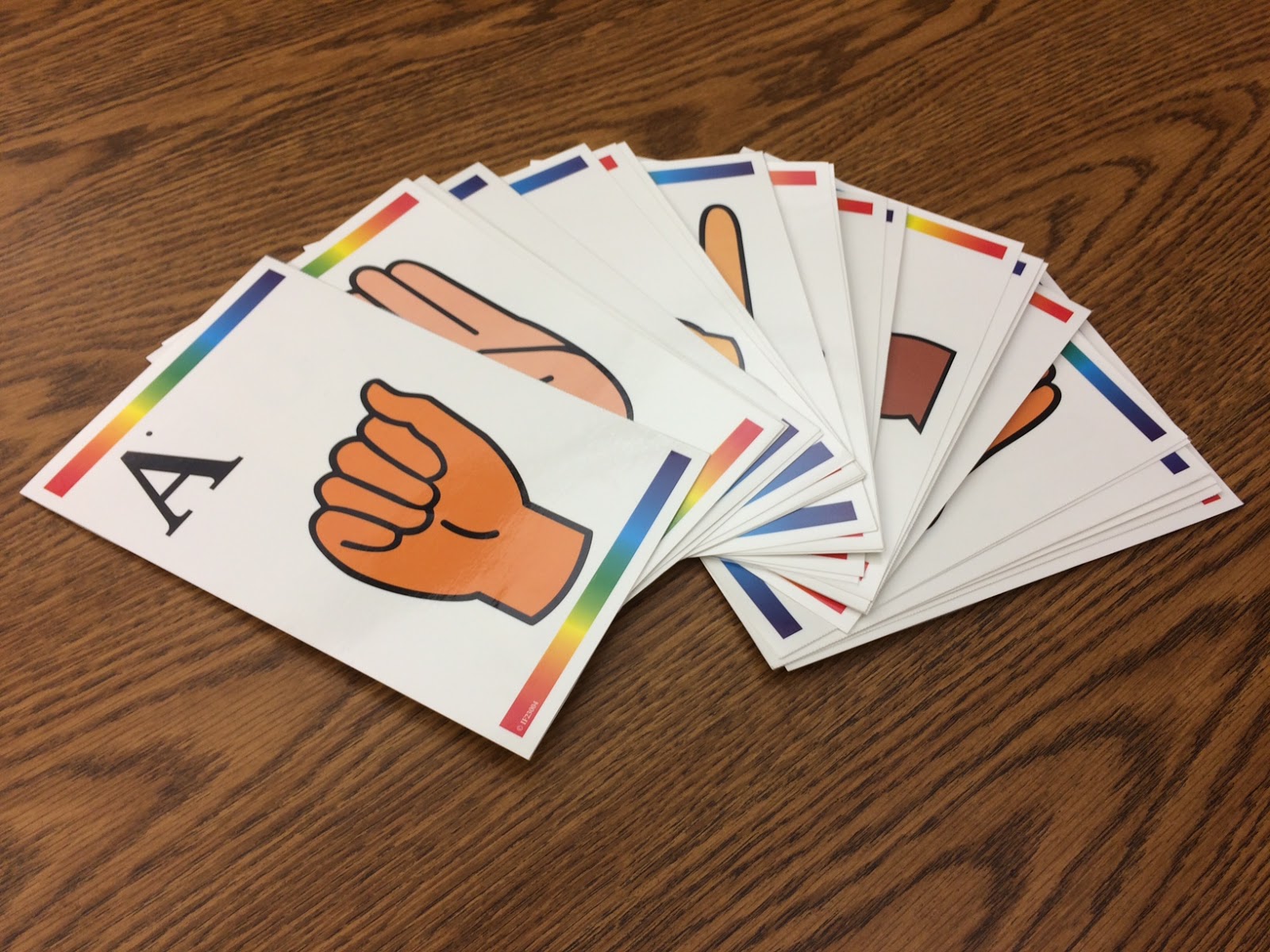
Flash Cards
I was lucky enough to find these in the deep dark depths of dusty nowhere (the back of the filing cabinet)! This was a great visual for the little ones since it's simple and just colorful enough.

ASL/Braille Blocks
These blocks circulate between branches, and I'm so glad we have them! I left them out most of the day and kids really enjoyed playing with them. They not only introduce them to sign, but also braille. This is a great language toy!

Printables via SignLanguagePrintables.com
I provided a copy of this sheet for each person that attended. The only thing I don't like about it, is that the numbers stop at 9 and not 10. Other than that, this is a great resource for the alphabet and numbers.

RECEPTION: This was such a fun storytime! Both parents and children seemed to have a lot of fun, and the signing helped to keep their attention. The songs were a hit. I had introduced "Twinkle, Twinkle" the week before with my ukulele, so they've been learning different variations of it. We had people from other branches join us for this specific storytime as well. A lot of the parents asked me to repeat certain signs from Goodnight Moon so they could use them with their child at home. I feel this storytime was a definite success.
Follow My Sign Language Pinterest Board.

9.13.2015

World Travelers: France

World Travelers: France
Grades K-5

My goal with this series is to bridge cultural gaps in children's literacy. The best part about it is that I learn a lot about the countries in the process, and even the parents get involved with asking questions. Sometimes I bring in a special guest or two that has lived or visited that specific country and they tell about their experiences and share items from there. The more this program develops, the better it gets!

Each child that attends gets a passport. I created a template to save ink, then filled in the space with the airplane and the quote with stamps. The inside pages are from this template, and each time a child comes to the program, they get a special stamp on the inside. If they "travel" to so many of the locations, they get a prize!

MUSIC
I found this snazzy playlist of French music on YouTube. It played in the background during the program.

OPENER
Foreign exchange student, Anne Sophia, was kind enough to come in and talk about life in France. She provided a power point that everyone really enjoyed. The kids were especially interested in talking about the food! Since the last program, the kids have started opening up more and becoming involved in the presentation.
 

FACT SEARCH
Each child received a page of questions and had to find the answers hidden around the room. Here are some random facts I used:
1. The name France comes from the Latin word Francia, which means 'country of the Franks.'

2. French is the second most studied language in the world after English.

3. The capital city is Paris. Other major cities include Marseilles, Lyon, Lille, and Nice-Cannes.

4. France is the most visited country in the world, with over 80 million visitors every year.

5. The Louvre is the most visited art museum in the world. The famous Mona Lisa painting is on display in this museum.

6. During World War II, allied forces landed on the beaches of Normandy in northern France. The first day of these landings is called D-Day.

7. The famous Eiffel Tower in Paris was built as the entrance point for the 1889 World Fair. It is one of the most visited monuments in the world.

8. France was the second country to host the modern Olympic Games in 1900 in Paris. Paris also hosted the games again in 1924. Three winter Olympics have been hosted in France.

9. The most famous road bicycle race in the world, the Tour de France, zig zags through the French landscape.

10. Louis Pasteur was a French scientist who made many discoveries in the fields of chemistry and microbiology.

ACTIVITY STATIONS
Each station has a description of the history and uniqueness of the specific craft they are making. I also provide examples as well.

Cave Paintings
The Chauvet Cave and Lascaux are France's hubs for some of the oldest cave paintings in the world, between 20,000-36,000 years old! I had to incorporate the awesomeness of cave painting, so I got a cardboard box, wrinkled brown paper, and some crayons. My first version of the structure lasted about 5 minutes. So I reconstructed it and this is what I ended up with (along with some cave drawings I started them out with): 

Monet's Water Lilies
This was a great way to introduce impressionist painting. It allowed the kids the opportunity for open creativity and they really enjoyed learning about Monet and his method of painting. I also covered Degas a little bit while I explained the project.

Materials:
Different shades of blue construction paper
Tissue paper
Scissors (although I would recommend ripping instead, to create that blurry Monet effect)
Glue
 

French Knitting
This was incredibly popular! I got the idea from BuzzMills. A lot of the parents asked me to print off the instructions so they could do it at home, too. Kids were wearing their creations throughout the library, it was great!

Materials:
Toilet paper roll
4 Popsicle sticks
Some nifty tape
Scissors
Yarn
   

Escargot
The French version of hop scotch! I just drew the game onto bulletin board paper so it was big enough to tape onto the ground.

How to play:
1. Decide which foot you will be hopping with. If you decide on your left foot, you must hop in and out each time on that foot.
2. Hop through the snail pattern
    a. Hop only once in each space. No player may touch a line when hopping.
3. In the center “home” space you may rest on both feet.
4. After resting, turn and hop back to the beginning. Repeat the pattern 1x.
5. After you have hopped in and out twice, choose one space for your “house”. Write your initials in this space. This becomes another rest space for you. No other player may hop into your house.


The game ends when it is impossible for anyone to hop into the center space or when all of the squares have initials in them. The player who “owns” the greatest number of squares wins.

Bilboquet
Pretty simple. Just get the pom pom in the cup. This is a versatile game that has different versions of itself all around the world.

Materials:
Cups
String
Pompoms
Whatever you wish to decorate the cups with
Something to puncture a hole in bottom of cups (since I had styrofoam, I just used a paperclip)

RECEPTION: Again, a very successful program! This was probably the biggest group I've had for this series thus far. I had lots of returning kids with their passports, and they became more involved with the speaker, too. The activities at this one were also a hit. 

After the presentation, Anne Sophia said she was really grateful to come and share about her country. The night before, I was thinking about what a great opportunity this could be for people who are far away from home. This has become a chance to not only bridge cultural gaps for children and their parents, but also for foreigners to share about their homelands while they're over here.  I could tell it meant a lot to her, and that expanded my entire perspective on this program. 

Check out my list of books related to France HERE.


Follow My France Board on Pinterest.

8.07.2015

Author Interview: Carole P. Roman - Cultural Children's Author


Carole P. Roman is a notable author to add to your storytime collection. She writes about pirates, frogs, yoga, and my personal favorite, culture. For an assignment at school, I had to develop a proposal for something within my chosen career that I was passionate about. The American Library Association put out an article from the School Library Media Research journal about bridging cultural gaps in children's literacy. In a nutshell, it suggests that kids are less likely to become strong readers if they can't relate to what they are reading (authors, characters, content, etc.). In 1985, the Cooperative Children's Book Center began documenting such information, and it looks a lot like this (the following chart is one I created for my project):


Roman noticed something else about the world around her. We are constantly surrounded by culture outside our own, but we don't understand how it relates to us. This epiphany inspired her to write the "If You Were Me and Lived In..." books. I love these books because they simplify cultures not just for children, but for adults, too! They are short enough for storytimes, and they allow children of different cultures to relate to what they're reading, while also educating their peers. I believe these books are the beginning of a new era in children's literature, and I hope we continue to see this gap diminish.

During research for my project, I had the opportunity to call Miss Roman and learn more about her aspirations via phone interview. The passion she has for reaching a generation of children and educating them to understand the world around them was evident in her voice. It was incredibly moving for me to hear her story and how she came to act upon her convictions to write about what she felt the world was missing. It inspired me to start a program at the library called "World Travelers" where I aim to educate children about different countries and their cultures.

Please welcome Carole P. Roman to The Indigo Quill with me, and be sure to check out her books for your collection!
Named to Kirkus Reviews' Best of 2012 for her first book, award winning author Carole P. Roman started writing as a dare from one of her sons. Using an imaginary game she played with her grandson as a base, Captain No Beard was born. It has followed with four more books to the series.

Motivated by her love of yoga, Roman has written a book that not only teaches four poses, but shows how easy and accessible yoga can be.
She has just finished the first of six books in a groundbreaking new nonfiction series about culture around the world. "If You Were Me and Lived in..." combines her teaching past with her love of exploration and interest in the world around us.

Writing for children has opened up a whole second act for her. While she is still working in her family business, this has enabled her to share her sense of humor as well as love for history and culture with the audience she adores. Roman lives on Long Island with her husband and near her children.


What inspired you to write multicultural books for children?
I’ve always been interested in different cultures. I have a multicultural background and I was a Social Studies teacher—I graduated as a History major and taught Jr High for a while before I and quit. 

One night, I just thought I should write about what I know. Alexander (my grandson) was in Vegas with me and didn’t understand the concept of different countries. So the first multicultural book I wrote was If You Were Me and Lived in Mexico… (because I lived closest to there).

I asked myself, what is culture and what does it mean? Alex was exposed to cultures but didn’t understand them. He’d ask what the eiffel tower was, and even after telling him, he still did not understand what it was and why it was relevant to him.

What elements do you ensure are included in your multicultural books?
I ask myself questions about what the child should know, such as…
  1. what would you call your parents?
  2. what could your name be?
  3. what a doll would be called?
  4. what would you call school?
I tackle things kids would read and make them understand why it’s diverse.

Where do you find your inspiration for which country you’ll write about next?
Restaurants…I write about what country the places I go inspire. Everywhere I go I notice I’m surrounded by these cultures. Korea, Greece, Kenya, Hungary…etc. We are surrounded by culture in everything we do!

How do the kids respond to learning about different cultures?
Kids are delicious and wonderful, and they love it!  They like to talk about themselves…so if they have some kind of relation or story with it they get excited.

I printed out post cards and would have them write about what they would know or do if they wanted to go there.

What do you hope your books achieve?
I feel the books are really important for tolerance. They give knowledge….the goal is to give children information and not hatred.

When I was a substitute teacher I had my class write down their Thanksgiving menu. The menu always had turkey, mashed potatoes, and pie. But there was always an ethnic dish. These kids are already experiencing culture and they don’t even realize it.

What is one thing you want readers to take away from reading your books?
The most important lesson that comes out of my books is that the world is very large, but  yet it is very small, and we are so connected. If we don’t learn to appreciate the differences and embrace them then the world is not going to be a safe place for our children. There is no better than the other, they are all beautiful! 

Each book has been a labor of love. 


6.28.2015

Storytime: Rainforest

RAINFOREST STORYTIME
Ages 0-6


BOOKS
Where Am I? by Moira Butterfield
The Salamander Room by Anne Mazer
The Umbrella by Jan Brett
The Great Kapok Tree by Lynne Cherry

OPENER
Lately we've been delving into the crevices of the children's department storage spaces to find any lost treasures that may have been forgotten. One of them is a collection of children's songs printed out and laminated to use during storytimes. We've been working on putting together a flip board by cutting out some cardboard, punching holes in the tops, and connecting them with rings. We're actually creating two boards because we have so many of these, but once we are finished with the second board I'll be making a CD with correlating music to accompany. For this particular storytime I  chose to start with The Grand Old Duke of York...because...why not?

BOOK Where Am I? by Moira Butterfield

BOOK The Salamander Room by Anne Mazer
   
STRETCH
Up to the Ceiling
Up to the ceiling, (stretch both arms overhead)
Down so you’re small. (bend at waist and touch floor)
Right to the bookshelf (stretch arm to right)
Left to the wall. (stretch arm to left)
Right hand, left hand,
Turn them around. (spin hands around each other, 'wheels on the bus style')
Fold them together
And now sit down

BOOK The Umbrella by Jan Brett (Interactive)

BOOK The Great Kapok Tree by Lynne Cherry 
  
THE UMBRELLA ACTIVITY
I got this idea from From the Hive. I printed off the animals from Jan Brett's website. I laminated them and cut them out, then cut out some felt to look like leaves. I then sewed the pieces together to create the "umbrella." I didn't really like the handle made of felt, so I took a long roll of industrial paper towl and twisted it together. Then I curved the end to create the handle. It made it more sturdy and multi-dimensional:

I handed each child a different animal, and when I read the story and their animal got into the umbrella, they came up and put their animal in the umbrella on the board, too (well...they tried):

ACTIVITY STATIONS
Clothes Pin Frog
How cool is this?? You can find the printable at Therapy Fun Zone. This is a great craft because it helps with finger strength. It's also fast and easy to make.

4 Foot Puzzle
This puzzle is always out with our Racing to Read toys, but it seems to intimidate people. I felt that it fit into the theme enough that I'd incorporate it, so I started the puzzle by connecting all the top pieces, and then let the kids finish it.


The Umbrella Coloring Mural via Jan Brett
This mural as a whole is pretty awesome, but I just needed a passive station without overdoing it too much, so I cut out some pieces to make a tree and set some crayons with it. We ended up leaving this one out for a while.

RECEPTION: This was such a fun storytime! The kids loved finding the blue butterfly on every page of Where Am I? The parents also enjoyed learning about animals they didn't know about during The Umbrella and there were some great questions to ask during The Salamander Room and The Great Kapok Tree. I felt like it was educational and interactive, and the kids kept on task pretty well. The frog craft was also a hit!


Follow My Rainforest/Jungle Board on Pinterest